About Me
- Pyro
- I am who I am. Don't try to change me, It won't work! Like me, love me, or get the hell out of my way! I have been described as an opinionated asshole in the past. Mostly by people that didn't like hearing what I had to say. I have also been decrribed as a very good friend to have when your butt's in the fire. If you are still reading this then maybe one day you will see that side of me, as you have passed the first test, you have listened.
Friday, April 8, 2011
What the mountains mean to me.
This is Johns Last song. It is called Yellowstone, coming home. This explains what the mountains mean to me.

Monday, March 28, 2011
Saturday, March 26, 2011
Wednesday, February 23, 2011
My thoughts on the access fund and climbers
Ok my friends, I started this post as a response to my brother Mikes post entitled "In my own defense" I personally feel he has nothing to defend against except maybe having to much belief in the peoples willingness to step up and do the right thing. But I digress.
When I started writing it was as a comment of encouragement but as I wrote and thought I started to get angry about my feelings towards the Impact I have seen at some of my favorite crags and the people climbing their. Then I realized that I was also mad at my own actions and inactions concerning said crag. It was at this point that I realized that in my distancing myself from popular crags and climbing groups in general I had become a part of the problem by not being a part of the solution. So on too my original writings in the original format. PLEASE let me know your thought and feelings on this issue.
Many good points here my Brother. I hope with all of my heart that people will take notice and understand the point being presented and not just jump to defend how much they have done by sending their check to the Access Fund and what they believe to be true. So I will do something that I seldom do anymore and climb up on the soapbox and give my views on a few things. So, here we go.
Point One:
We are all stewards of the land we use every single time that we use it, not just on trail day events and Access events like adopt a crag clean up. As a whole we need to be picking up our trash and packing it out with us. Even something as small as walking through the crag at the end of our day and looking for and picking up whatever is found and packing it out will go a long way. If every single climber would take 5 minutes at the end of the day to just do general stewardship duties when we have big events at the crags we could get a lot more done.
Point Two:
Ok now on to another issue. Trail maintenance, the trails do not just show up out of good wishes and dreams. They are put in by a very few hard working individuals donating their time away from loved ones, their sweat at the end of a long week working their real jobs, and the very blood that flows through their veins from smashed fingers and skinned knuckles, from blisters generated by working for you, the climber. Now knowing that all of this done so that you can easily walk to and from the crag in safety, is it to much to ask, of you the climber, to bend over and pick up that rock in the trail? Is it to much to ask that you fix the trail if it collapses when you walk along the outside edges? When you walk up a set of steps and see a stepping stone lose too put it back in place securely? These trails where put in for you, is it too much to ask that you take five minutes to help maintain them for everyone.
Point Three:
Ok now on to a subject that I personally find to be a source of heart ache and pain every time that I see it, OVER USE. There is nothing that pains me more then to see an area ounce beautiful, beaten into submission, vegetation destroyed, the turf non existent, erosion running rampant. Then you see dozens of people here every time that you are their destroying more and more, you see the problem getting worse and worse and you think to yourself something needs to be done. But still you come to the same crag again and again, climb the same routes again and again, and all the time thinking to yourself what this area used to look like and how someone needs to fix it. Well here is what needs to happen, water breaks need to be installed to stop the erosion, the area needs to be re-seeded, Vegetation needs to be re-planted including bushes and trees. Then the area needs to be closed to allow the area to recover. Which means that YOU will need to stop going here, you need to help in the effort of reclaiming and fixing what you have destroyed.
Ok friends, I’m off the soap box now. I will share one more thing on a personal note now and be done. I have lost my interest in many popular climbing areas and in climbers in general in the last few years. I had decided that if I didn’t like what I saw at the crags I would distance myself from them and from the problems their by finding and climbing new areas and by climbing alone or with like minded friends. I have re-thought that principle in the last year. I realized that I was a part of the problem and then did nothing to fix what I helped to screw up when I went off on my own trail. I am back on the right path. My brother and my true friend Mike has shown me that there are like minded people out climbing today. There are people out here today that toil away on their own time and dime trying to rectify years of miss use. They are building trails, packing out your trash. They are the ones re-seeding and re-planting vegetation, the ones building the water breaks to control erosion. They are the ones that are behind the scenes toiling and sweating away for you and your friends. Then they ask you, the climber, to please help in the easiest way, they ask that you not climb in an area until the vegetation has a chance to take root and grow. Because folks, the vegetation is the key here to stopping erosion. Now folks how do you repay all of this effort? You continue to climb the routes you always have you trample the planted bushes and trees, you grind the seeds into nothingness, you break down the water breaks, you destroy the trails. Then when the kind hearted individuals go on line and post what has occurred you call them liar’s you make snide comments, you belittle, you try to make yourself look big. You talk about the access fund. You talk trail days, you talk sir, and that is the problem, all you do is talk. So to the climber, I ask you this, what have you done for the good of your crag today besides write a check?
Pyro
Wednesday, February 2, 2011
Vision Quest
A vision quest is a rite of passage, similiar to an initiation, in some Native American cultures. It is a turning point in life taken before puberty to find oneself and the intended spiritual and life direction. When an older child is ready, he or she will go on a personal, spiritual quest alone in the wilderness, often in conjunction with a period of fasting. This usually lasts for a number of days while the child is tuned into the spirit world. Usually, a Guardian animal will come in a vision or dream, and the child's life direction will appear at some point. The child returns to the tribe, and once the child has grown, will pursue that direction in life. After a vision quest, the child may apprentice an adult in the tribe of the shown direction (Medicine Man, boatmaker, etc).
The vision quest may be a part of shamanism, more exactly, the learning and initiation process of the apprentice for achieving the ability for shamanizing, mostly under the guidance of an older shaman.
A vision quest may include long walks in uninhabited, monotonous areas (tundra, inland, mountain); fasting; sleep deprivation; being closed in a small room (e.g. igloo). The technique may be similar to sensory deprivation to a rite of cleansing and purification. One objective is to commune with the other side.
In traditional Lakota culture the Hanblecheyapi (vision quest, literally "crying for a vision") is one of seven main rites. Vision quest preparations involve a time of fasting, the guidance of a tribal Medicine Man and sometimes ingestion of natural entheogens; this quest is undertaken for the first time in the early teenage years. The quest itself is usually a journey alone into the wilderness seeking personal growth and spiritual guidance from the spirit, sometimes Wakan Tanka. Traditionally, the seeker finds a place that they feel is special, and sits in a 10 foot circle and brings nothing in from society with the exception of water. A normal Vision Quest usually lasts two to four days within this circle, in which time the seeker is forced to look into his soul.
It is said that a strong urge to leave the quest area will come to the seeker and a feeling of insanity may set in. However, the seeker normally overcomes this by reminding him or herself of the overall outcome of the quest, causing the mind to stop wandering on random thoughts. The individual can generally find solace in the fact that he or she will not die in just two to four days.
Some have claimed grand visions on their first Vision Quest while others have not. It is an individual experience and often subject to the emotional, spiritual, and physical make-up of the person.
Native American totems are said to be capable of speaking through all things, including messages or instructions in the form of an animal or bird. Generally a physical representation of the vision or message such as a feather, fur or a rock is collected and placed in the seeker's medicine bag to ensure the power of the vision will stay with the individual to remind, protect or guide him.
Since the beginning of this cycle of time, humanity has returned to nature to connect with spirit and to seek answers to problems of the physical realms, especially in this timeline when the messages of prophecy reveal themselves to the seeker.
There is something about being alone in the wilderness that brings us closer and more aware of the 4 elements and our connection to a creational source. We go to seek truths and divine realization, just as many of the ancient prophets did in their time.
In its own way, the vision quest is an Initiation not unlike the days of the ancient mystery school teachings where one learns about themselves and the mysteries of the universe are often revealed to them. It is a time of internal transformation and renewal. Who am I? Why am I here? Physical surroundings allow the soul to move into the grid or the collective unconsciousness.
Though the Vision Quest is associated with Native Americans traditions - it is practiced all over the world. As an expression of the archetypical "Heroic Journey," the vision quest has been enacted in religious pilgrimages, mythological tales (including the story of the search for the Holy Grail), and our own daily pursuit of truth and purpose. Today, there are companies that sponsor these journeys. They provide a wilderness area in which it is to occur, and they give instructions and guidance before and after the event. It might take a day, a week, a month - whatever is necessary to complete the transformation and get the answer one seeks.
Preparation:
- able to fast
- able to camp out for long periods of time
- knowledge of first aid
- prepare sleeping equipment - or sleep on the ground.
- knowledge of spiritual things like meditation
- bring a spiritual instrument so you can play or chant
- be comfortable with the solitude
- if the weather permits you may wish to remove all clothing or cover yourself in a blanket
- create a sacred stone circle on the ground in which the person sits
- a journal to record your experiences
Now you are ready to go out alone in nature to spend the time seeking greater truths through dreams, meditations or hallucinations. This transformational experience has been sometimes been done with the use of hallucinogens such as peyote, mescaline, and the South American Iawaska plant during sacred initiation rites. These plants were held as sacred teachers from the plant kingdom. The insights during the sacred space allowed the veils between this world and the next to be pulled back and for the individual voyager to transcend himself and this dimension. You may, or may not, understand the messages received. It may take time for you to process affecting dreams, synchronicities and more in your life.
The benefits of a vision quest
Curing emotional, physical, spiritual illnesses
Discover your mission here
Commune with nature, spirit, your spirit guides or deceased ancestors
Move beyond outmoded paradigms
Find truth, balance and peace
--------------------------------------------------------------------------------
Vision Quest
A Vision Quest is an experience of deeper understanding of Nature and Spirit. It is a ceremony practiced by American Indians.
To prepare for this "insight" one must first cleanse the body and mind by going through a Inipi or sweat lodge.
Then with the help of a Holy Man is told certain things and must go to a spot, usually on a holy mountain, and stay 2 or 3 days
During this time no food is eaten and one does not sleep but spends the time in deep prayer and observation.
Many times, but not always, there is a vision. This vision is then shared with the Holy Man to help learn of its meaning.
Sometimes the meaning is not shown for several years afterward.
This is part of a vision quest I was told to share with all who may be interested.
Once, I went to pray at the top of the sacred mountain of my ancestors.
As I climbed to the top I heard voices singing as the wind blew the leaves.
At the top I saw, made from many stones, a large circle with a cross inside.
I knew from my teachings that this represented the circle of life and the four directions.
I sat down by the edge of this circle to pray.
I thought this is only a symbol of the universe.
"True," a very soft voice said.
"Look and you will see the Center of the Universe.
Look at every created thing."
As I looked around I saw that every created thing had a thread of smoke or light going from it.
The voice whispered, "This cord that every created thing has is what connects it to the Creator.
Without this cord it would not exist."
As I watched I saw that all these threads, coming from everything, went to the center of the circle where the four directions were one place (the center of the cross).
I saw that all these threads were tied together or joined here at this spot.
The voice spoke again, "This is the Center of the Universe. The place where all things join together and all things become one. The place where everything begins and ends. The place inside everything created."
That's when I understood that all of creation, the seen and the unseen, was all related.
The voice spoke one last time, "Yes, now you know the Center of the Universe."
I pray to the four directions.....hear me.
I pray to the West which gives us rest and reflection.
I thank you for these gifts for without them we could not live.
I pray to the North which gives us patience and purity.
I thank you for these gifts for without them we could not live.
I pray to the East which gives us energy and emotions.
I thank you for these gifts for without them we could not live.
I pray to the South which gives us discipline and direction.
I thank you for these gifts for without them we could not live.
Grandmother, share with me your wisdom, and I thank you for this gift.
Grandfather, share with me your strength, and I thank you for this gift.
National Park Service Releases New Wilderness Policy on Climbing Fixed Anchors
After years of anticipation and direct advocacy by the Access Fund, the National Park Service has released an updated draft of its wilderness management policies in order to provide accountability, consistency, and continuity in its wilderness stewardship program. The update covers a wide range of topics including the long-waited-for provisions specific to climbing fixed anchors. Iconic climbing areas in the U.S.—including as Yosemite, Zion, Black Canyon, and Rocky Mountain national parks—would be governed by this new policy.
The proposed policy acknowledges that climbing is a legitimate and appropriate use of wilderness and that each park with significant wilderness climbing activities must prepare a climbing management plan. However, the policy calls for climbing to be restricted or prohibited if unacceptable impacts to wilderness resources or character occur.
This proposed policy recognizes that the occasional placement of a fixed anchor for belay, rappel, or protection purposes does not necessarily impair wilderness, but it requires prior authorization for the placement of new fixed anchors (replacements or removals may also require park approval). The requirements and process for authorization are to be laid out in each park’s climbing management plan.
The practical outcome of this proposed policy is that climbers would need a permit or some other authorization prior to the hand-placement of new bolts in any national park wilderness area. Most parks currently require no such prior-approval. The public will have 60 days to comment on this proposed policy revision.
Friday, January 28, 2011
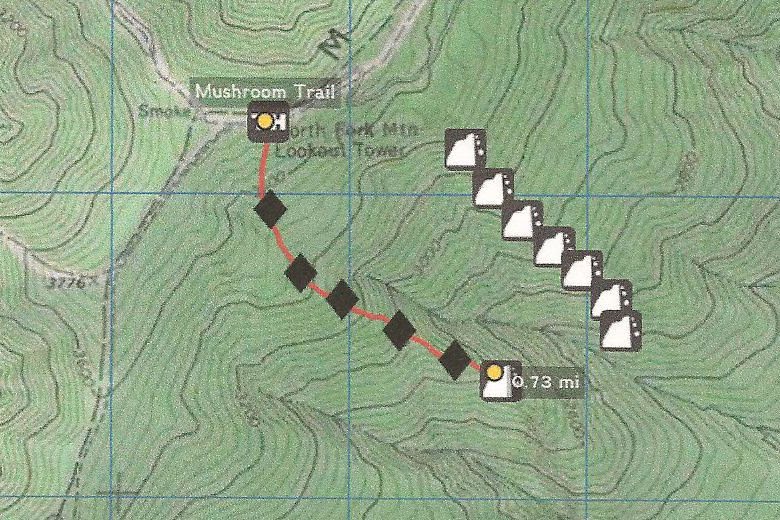
The Mushrooms
This was a very good trip with a very good friend. Everyone this IS WHAT WE DO. Their is so much to do here from climbing to camping to kayaking. Just camping in this area is a lot of fun. To everyone that not been here before you had better make it out soon. If you don't we will just keep all of this undiscovered or forgoten rock to our selves. At least until we have climbed it all that is. Come on a trip with us, See new things. Put your hands on some rock that may never have been touched by anouther in the last 100 years. Come on, You know you want to.
Pyro
Friday, January 21, 2011
AftonMountain tunnel
Monday, January 18, 2010
Afton Mt tunnal,
When railroads in Virginia were beginning to expand to the western part of the state in the mid-1800's, the Blue Ridge mountains stood as a formidable obstacle to their progress. In 1848, construction began on a series of tunnels (Crozet Tunnel being the longest) to link the Shenandoah Valley to the eastern part of the state. The tunnel was engineered by Claudius Crozet, and stands as one of the great engineering wonders of the 19th century.
The tunnel itself is 4281 feet long (that's almost a mile!), and for many years was the longest railroad tunnel in the world, and the longest tunnel drilled without the aid of vertical shafts. When the two ends of the tunnel met on Christmas day, 1856, they were a mere 1/2" out a alignment, an amazing testament to Crozet's engineering skill. The tunnel opened to rail traffic in April of 1858, and was in use for almost a hundred years. In 1944 C&O opened a new tunnel nearby to handle taller freight cars, and the Crozet Tunnel was abandoned.
In the early 1950's, a plan was proposed to use the tunnel for natural gas storage. Two 14' thick walls were constructed within the tunnel, but the project was abandoned before the concrete was completely sealed. There is still plenty of debris from this project left over in the tunnel, such as rusty pipes and paint cans.
The western entrance to the tunnel is a stone arch, about 20' tall by 16' wide. The tunnel is lined with several layers of brick. The top layer of brickwork has fallen from the walls in some places, leaving piles of rubble on the tunnel floor. As you can see from the first picture, there was a layer of fog in the tunnel, which decreased visibility and reflected light from my headlamp back in my eyes. 1500' into the tunnel, the brick lining ends, and from here on the tunnel walls are natural rock. Marks from the hand-powered drills used by the Irish laborers are still visible in places. At the point where the brick lining ends, a veil of water cascades from the ceiling. It was here that Crozet devised an 1800' siphon to carry water away during construction, supposedly the longest siphon ever used.
A short ways after this, the first wall in encountered. Water dripping from the ceiling puddles up against this wall (heading east, the tunnel slopes downhill), and drains through a 24" pipe near the base. The pipe is 16' or so long, and is the only way through the wall. The stretch between the two walls is much like a cave... the floor is rough, jagged rock, and there is a lot of water. There are rusted metal brackets coming out of the floor every 10' or so, I imagine that they were to hold pipes for the natural gas storage project. The echoes at the halfway point between the two walls are simply amazing. Eventually the second wall appears - it has a long, knee-deep puddle of water before it, and yet another pipe to crawl through. This wall is close to the eastern end of the tunnel, so light from the entrance comes through the pipe.
After the second wall, it's just a short walk to the eastern entrance. Water pours from the tunnel walls at one spot, and collects at the entrance of the tunnel, forming another long, knee-deep puddle. The eastern tunnel entrance isn't nearly as attractive as the western entrance, being carved through rock instead of having a stone and brick archway.
Planning is reportedly underway for turning the Crozet Tunnel into a public biking & hiking trail, to be open before 2010. Some funding and land has been secured, but the future of this project is still up in the air. The two concrete walls in the tunnel would have to be removed, the brick lining may have to be repaired or reinforced in places, but otherwise this seems like a great idea. Everyone should have the opportunity to safely see this engineering and historical marvel.
Posted by Pyro at 9:21 PM 0 comments
Sunday, January 9, 2011


Monday, December 27, 2010
20. Dezember 2010
Heute war Avery fn Tag Fr. mir. Kevin genannt und wir vereinbarten, hallo Massnuttan Berg für einige Nacht-Skifahren gehen. Dies wurde zuerst Geschmack der Nachtskilauf ths Jahr andi liebte jede Minute davon. Keven tut ver. gut.
Pyrotechnicker
Pyrotechnicker
So, we'll go no more a roving
I.
Also, wir gehen nicht mehr ein Roving
So spät in die Nacht,
Obwohl das Herz noch so liebevoll,
Und der Mond so hell sein wie vor.
II.
Für das Schwert outwears der Scheide,
Und die Seele trägt, die für die Brust,
Und das Herz muss pausieren zu atmen,
Und die Liebe selbst ruhen.
III.
Obwohl die Nacht war für die Liebe gemacht,
Und der Tag kehrt zu früh,
Doch gehen wir nicht mehr ein Roving
Durch das Licht des Mondes.
Sunday, December 26, 2010
When a man hath no Freedom to fight for a home
When a man hath no freedom to fight for at home,
Let him combat for that of his neighbours;
Let him think of the glories of Greece and of Rome,
And get knock'd on the head for his labours,
To do good to mankind is the chivalrous plan,
And is always as nobly requited;
Then battle for freedom wherever you can,
And, if not shot or hang'd, you'll get knighted.
Highland Mary
Yebanks and braces and streams around
The castel o' Montgomery,
Green be your woods, and fair your flowers,
Your waters never drumlie!
There simmer first unfauld her robes,
and there the langest tarry;
For there I took the last fareweel
O' my sweet Highland Mary.
How sweetly bloomed the gay green birk,
How rich the hawthorn's blossom,
As underneath their fragrant shade
I clasper her to my bosom!
The golden hours on angel wings
Flew o'er me and my dearie;
For dear to me as light and life
Was my sweet Highland Mary.
Ei' monnie a vow and locked embrace
Our parting was fu' tender;
And, pledging aft to meet again,
We tore ourselves assunder;
But oh! fell Deaths untimely frost,
That nipped my flower sae early!
Now green's the sod, and cauld's the clay,
That wraps my Highland Mary!
O pale, pale now, those rosy lips
I aft hae kissed sae fondly!
And closed for aye the sparkling glance
That dwelt on me sae kindly!
And mold'ring now in silent dust,
That heart that lo'ed me dearly!
But still within my bosom's core
Shall live my Highland Mary.
Sunday, December 19, 2010
127 Hours, Between a Rock and a HARD plac Arron Ralston
I reckoned this book too anyone who climbs. It will give you an incite into what can be survived when everything goes wrong. Aron has got to have Big Brass Balls (B3) when he walks. How many of you out their would have the testicular fortitude really sit and think on this one for Min. Then ask your self could I do that too free my self.
.http://www.youtube.com/watch?v=B2XLoQ1xYB0
.http://www.youtube.com/watch?v=B2XLoQ1xYB0
Food Link
I know I have been working very slowly posting to my blog but I do have some stuff I have been working on. Until they have been compleated check out this site. I don't know about everyone else but I have found Mountain House meals to be over priced and not really that good. So I think I will be tring to make my own. If any one has any ideas or recomendations please comment and give me your ideas and I will try to incorparate them in also. Recipies Welcome.
http://www.trailcooking.com/
http://www.trailcooking.com/
Sunday, December 5, 2010
Cherokee Prayer Blessing
May the warm winds of
Heaven
Blow softly upon your house
May the Great Spirit
Bless all who enter
Their
May your Mocassins
Make Happy tracks
In Many snows,
And may the rainbow
Always touch your
shoulder.
The Native American Ten Commandments
1. The Earth is our Mother;
Care for Her
2. Honor ALL your
Relations.
3. Open your Heart and
Soul to the Great Spirit.
4. ALL Life is Sacred;
Treat all beings with
Respect.
5. Take from the Earth
what is Needed and
Nothing more.
6. Do what needs to be
done for the Good
of All.
7. Give Constant Thanks to
Great Spirit for
Each new Day
8. Speak the Truth but
only of the good
in Others
9. Follow the Rythms of
Nature;
Rise Early and then
Retire with the sun.
10 .Enjoy lifes journey,
But leave no tracks
Sunday, November 28, 2010
A Taste of Pyro's Rock

Trees go wandering forth in all directions with every wind, going and coming like ourselves, traveling with us around the sun two million miles a day, and through space heaven knows how fast and far!
 Keep close to Nature's heart... and break clear away, once in awhile, and climb a mountain or spend a week in the woods. Wash your spirit clean.


A few minutes ago every tree was excited, bowing to the roaring storm, waving, swirling, tossing their branches in glorious enthusiasm like worship. But though to the outer ear these trees are now silent, their songs never cease.

Everybody needs beauty as well as bread, places to play in and pray in, where nature may heal and give strength to body and soul.

How glorious a greeting the sun gives the mountains!
Subscribe to:
Posts (Atom)